The Samizdat Spirit - How We Fought Back Then, and Why We Must Now

- Published on
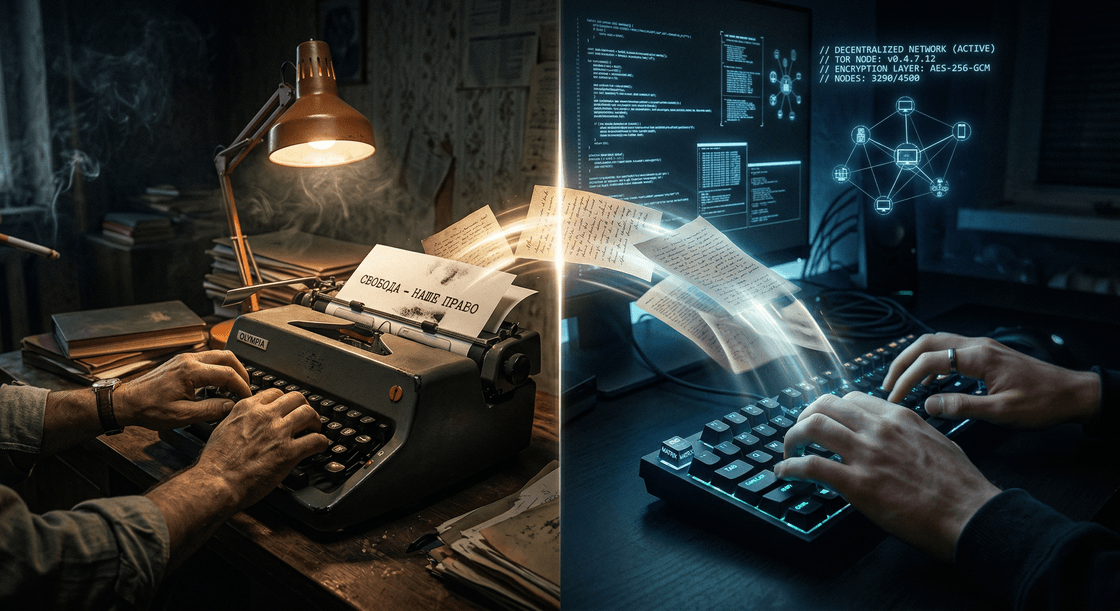
The historical parallel between modern tech legislation and 20th-century authoritarianism is stark. While the Soviet Union offers a textbook example of how absolute control over speech destroys a society, it also provides one of the most powerful blueprints for resistance.
The story of how human beings will always find a way to share the truth, even under the most crushing surveillance states in history, is a testament to the human spirit. In the Soviet Union, that resistance took the form of Samizdat.
The Analog Underground: How Samizdat Worked
Samizdat translates literally to "self-publishing." Because the state (through the Glavlit censorship board) controlled every official printing press, newspaper, and publishing house, citizens had to create their own decentralized, offline internet to share banned literature, news, and dissenting thoughts.
Here is how this incredible underground network operated:
The Mechanics (Typewriters and Carbon Paper): Owning a personal printing press was illegal, and typewriters were often registered with the state so the KGB could track specific keystroke impressions. A person would get a banned text (like Orwell's 1984 or Solzhenitsyn's The Gulag Archipelago), sit at a typewriter, stack sheets of paper with carbon paper in between, and type the entire book out by hand.
The Peer-to-Peer Distribution Network: Distribution relied entirely on profound, unspoken trust. You would give a copy to a trusted friend. That friend had 24 hours to read it, type out their own carbon copies, and pass it along to their trusted friends. Because there was no central hub, the KGB couldn't just "shut down the server." If they arrested one person, the literature was already moving through a dozen other hands.
The Risk and The Cost: The bravery required was immense. Under Article 58 (and later Article 70), possessing Samizdat could lead to years in a labor camp, imprisonment in a psychiatric ward, or the loss of your job and housing. Despite this, millions participated, understanding that the death of free speech meant the death of their own minds.
Magnitizdat (The Audio Rebellion): As reel-to-reel tape recorders became available, citizens created Magnitizdat ("tape-publishing"). They secretly recorded underground bards singing satirical or anti-state songs, copied the tapes, and passed them around—the Soviet equivalent of sharing unapproved podcasts, completely bypassing state radio control.
Samizdat completely eroded the Soviet state's monopoly on truth. The government could broadcast on state television that the economy was booming, but citizens reading Samizdat knew the reality. When the system collapsed in 1991, it was largely because the population had spent decades quietly sharing the truth in the shadows.
The Tip of the Spear: Lithuania's Resistance
Lithuania's fight against the Soviet Union is one of the most powerful examples of a society completely dismantling a massive surveillance state. They didn't just resist; they were the first Soviet republic to declare independence, acting as the tip of the spear that shattered the USSR.
The Forest Brothers (1944–1953): When the Soviets re-occupied Lithuania, bringing deportations and KGB informants, roughly 50,000 Lithuanians retreated to the forests to wage guerrilla war. They destroyed voter registries to prevent rigged elections, targeted informants, and published underground newspapers from bunkers, making it incredibly costly for the Soviets to establish their panopticon.
The Ultimate Samizdat (1972): Dissidents started publishing The Chronicle of the Catholic Church in Lithuania. Nuns and priests secretly typed it and smuggled it to the West, where it was broadcast back via Radio Free Europe. Despite massive KGB manhunts, the Chronicle never missed an issue for 17 years.
The Singing Revolution and Sąjūdis (Late 1980s): Because political organizing was illegal, Lithuanians used traditional folk songs. Hundreds of thousands gathered to sing banned national songs, giving birth to Sąjūdis, a grassroots reform movement. It proved that once people realize they outnumber the surveillance state, fear disappears.
The Baltic Way (1989): On August 23, 1989, approximately two million people joined hands to form a continuous human chain spanning 420 miles across Lithuania, Latvia, and Estonia. It was a massive physical rejection of Soviet control that no secret police could stop.
The Defense of the Television Tower (1991): After declaring independence, the Soviet military sent tanks to seize the TV tower in Vilnius. Unarmed civilians formed a human shield to protect the free press. Fourteen were killed, but the broadcast continued long enough to show the world the truth, marking the definitive end of Soviet power in Lithuania.
The Modern Threat: Chinese-Style Digital Authoritarianism
The jump from the Lithuanian resistance to the modern fight for digital free speech in the US is the exact parallel we must draw. What the KGB tried to do with human informants and carbon paper, China has successfully automated with algorithms and real-name registration.
China studied the Soviet collapse and realized that to maintain absolute control in the 21st century, the state must control the very architecture of the internet. Here is why resisting digital ID checkpoints is crucial to avoiding this fate:
The "Real-Name Verification" Trap: The cornerstone of China's Great Firewall is the total eradication of online anonymity. You cannot buy a SIM card or use social media without tying it to a government ID. When US lawmakers push for mandatory age verification APIs at the OS level, they are laying the exact same backend infrastructure. Once built for "safety," it can be repurposed to track and penalize unapproved speech.
The Social Credit System and the Chilling Effect: In China, speech is economically and socially penalized. Posting the "wrong" opinion lowers your algorithmic "social credit" score, locking you out of train tickets or loans. We are seeing the beginnings of this with financial de-platforming in the West.
The Automation of Censorship: The KGB hired thousands of humans; China uses AI to scan billions of messages in real-time. The First Amendment protects Americans from the government openly banning speech, but the danger lies in the privatization of censorship—when the government pressures tech companies to algorithmically throttle dissenting voices.
Centralized Databases as Weapons: A surveillance state requires massive, centralized databases. If a government mandate forces platforms to authenticate every user's identity, it creates a honeypot, shifting the internet from a decentralized network into a gated community where authorities hold the master keys.
The Loss of the "Immune System": Free speech is a society's immune system. China's initial suppression of whistleblowers during the COVID-19 outbreak shows how silencing dissent leads to catastrophe. The US has thrived because it allows messy, critical speech. The moment we prioritize "safety" over free speech, we lose the ability to course-correct.
The Bottom Line
The Lithuanians stood in front of Soviet tanks to protect their television tower because they knew losing the right to broadcast the truth meant losing their country. Today, the tanks are replaced by legislation that quietly redesigns our software infrastructure.